Article
Apr 26, 2026
AI for Listing Agents: The Operator Playbook for More Listings and Fewer Days on Market
The integrated playbook listing agents actually need — prospect discovery, pre-listing nurture, presentation, and days-on-market compression, wired into one system

TL;DR — The Honest Version
Prospect discovery is a commodity. Everyone buys the same expired and FSBO lists. The lever is who you reach first and what you say second.
Pre-listing nurture is the stage almost every agent skips. It's also where 30–60 day listing wins are decided, before the presentation ever happens.
Listing presentations convert ~33% on average. Agents running an AI-backed pricing and marketing story are pushing that toward 1 in 2.
Days on market is now a feedback-loop problem, not a price problem. The bottleneck is buyer-agent showing intel that never makes it back to the seller.
A wired system across all four stages typically takes 60–90 days to show measurable lift. The agent's daily routine barely changes; the system runs underneath.
Table of Contents
The real problem isn't the model
Where AI actually moves the listing pipeline
Stage 1 — Prospect Discovery
Stage 2 — Pre-listing Nurture
Stage 3 — The Listing Presentation
Stage 4 — Days-on-Market Compression
The numbers that make or break the pitch
What it costs to wire up
FAQ
How Do Listing Agents Use AI to Win More Listings?
Listing agents win more listings by wiring four stages into one system: predictive seller scoring to find homeowners 6–12 months before they list, an automated nurture sequence that builds familiarity before any competitor knocks, an AI-prepared listing presentation with hyperlocal pricing and marketing data, and a showing-feedback loop that pulls intel from buyer agents within 24 hours so price and staging adjustments happen on day 14 instead of day 45. Top producers using this stack are reporting listing-presentation conversion lifts from roughly 33% to 45–55%, and median days-on-market compression of 20–35% against their own prior baseline. The pieces exist. The work is wiring them into one decision loop with the agent above it.
The Real Problem Isn't the Model — It's the Pipeline
Look — if you're a listing agent, you've already sat through three AI demos this quarter. None of them solved your actual problem.
Your problem isn't generating content. It's generating listings. And the pipeline that produces listings has four distinct stages, each with its own failure mode, each requiring a different kind of system.
Most AI tooling sold to listing agents fixes Stage 1 (prospect discovery) and pretends the other three stages don't exist. That's why the listicle problem keeps repeating: 35 tools, all working on the same 20% of the funnel, none of them talking to each other. (You can buy 35 dashboards or you can buy one decision loop. Your call.)
The operators we work with at Entropy don't think in tools. They think in stages, KPIs per stage, and what the agent has to decide versus what the system can decide on its own. That distinction is the whole game.
Where AI Actually Moves the Listing Pipeline
Four stages. Each one has a measurable KPI. Each one has a specific place where AI earns its keep — and several places where it doesn't.
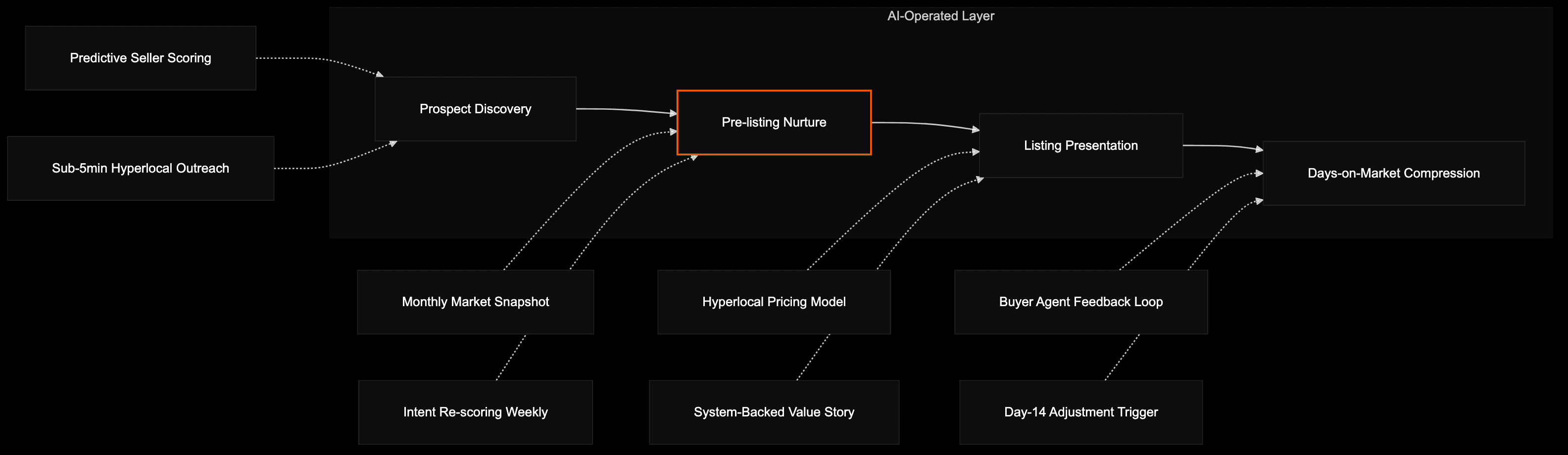
The four-stage system. Stage 2 is where most agents have nothing — and where the listing is actually won.
Notice the accent on Pre-listing Nurture. That's deliberate. Almost every listing agent we audit has Stage 1 covered (they buy lead lists) and Stage 3 covered (they have a listing presentation deck). Stage 2 is empty. Stage 4 is broken. The two stages that decide whether you actually win and actually sell fast are the two stages nobody runs.
Let's walk each one.
Stage 1 — Prospect Discovery: Beating the Same-List-Everyone-Buys Problem
The expired and FSBO lists are commodities. Every agent in your MLS gets them by 7 AM. REDX reports that 44% of expired sellers relist with a new agent within 30 days, and roughly 38% of FSBOs eventually list with an agent. Those numbers aren't secret. The competition for those leads is brutal precisely because the data is.
The lever isn't the list. It's the response time and the personalization layer on top of it.
Three things actually move Stage 1:
Predictive seller scoring on your existing CRM. Smartzip claims 72% accuracy on 6–12 month seller intent prediction. Lofty's Homeowner Agent, launched April 2026, turns existing contacts into ranked seller leads. Your past clients and sphere are a better list than any vendor's, if you actually score them.
Sub-five-minute outreach. The MIT Lead Response Management Study found leads contacted within 5 minutes are roughly 100x more likely to convert than those contacted after 30 minutes. Most agents respond in hours. An agent with a system responds in seconds.
Hyperlocal personalization at draft time. The first message references their specific street, the last three sales within 0.3 miles, and the equity position the public records imply. Generic merge tags get deleted. Specific signals get read.
Stage 1 KPI: contact-to-conversation rate. Operator benchmark: from ~8% (cold outreach) to 18–25% (scored + sub-5-minute + hyperlocal).
Stage 2 — Pre-listing Nurture: The Gap That Wins More Presentations
Here's the stage nobody runs. A homeowner who's 6–9 months from listing doesn't want a listing presentation. They want a market read.
The agent who shows up monthly with a one-page neighborhood update — not a pitch, an update — is the agent invited into the kitchen first when the listing decision happens. Familiarity beats credentials in the seller's mental model. By the time three agents are interviewing, you're already inside.
A pre-listing nurture system, wired correctly, does four things on autopilot:
Generates a personalized monthly market snapshot per scored prospect (not a newsletter — a their-house-specifically report).
Tracks engagement signals (open, click, reply, time-on-page) and re-scores intent weekly.
Surfaces the 5–10 prospects each week who crossed an intent threshold and need a human call this week.
Logs every touch in your CRM so the listing presentation references the 7 months of value you've already delivered.
That last bullet is the move. When you walk into the presentation, you don't introduce yourself. You reference the report you sent in March that flagged the comp three doors down. The competition is still on slide 4 of their generic deck.
Stage 2 KPI: nurture-to-presentation invite rate. Operator benchmark: 12–18% of nurtured prospects invite you to present within 12 months, versus 2–4% from cold sphere outreach.
Stage 3 — The Listing Presentation: What Your Value Story Should Be
If your presentation is still "here's my marketing plan and my last five sales," you're competing on craft. Every agent has craft. The presentation that wins in 2026 sells a system, not a person.
What the seller actually wants to know:
What will my house realistically sell for, and how confident are you in that number?
How fast, and what's the plan if it doesn't move?
What happens between days 1 and 45 that I won't have to manage?
An AI-backed presentation answers all three with specifics. Pricing comes from a model trained on your local MLS plus the last 90 days of micro-comps, with confidence intervals you can defend. The marketing plan shows the auto-generated listing description, the staging recommendations from a vision model, the buyer-agent showing-feedback loop you're going to run (more on that next), and the price-adjustment trigger logic you'll execute on day 14 if the showing rate is below benchmark.
That's not a pitch. That's an operating system the seller is buying. The conversion data we see across brokerages running this stack: presentation win rates moving from the industry-typical ~33% toward 45–55%, depending on market and agent tenure.
Stage 4 — Days-on-Market Compression: The Showing-Feedback Loop
This is where most listings quietly bleed out. NAR data shows longer median days-on-market and more frequent price adjustments through normalized 2026 cycles. The reason isn't pricing — it's that price adjustments come 3–4 weeks too late, because nobody's running the feedback loop.
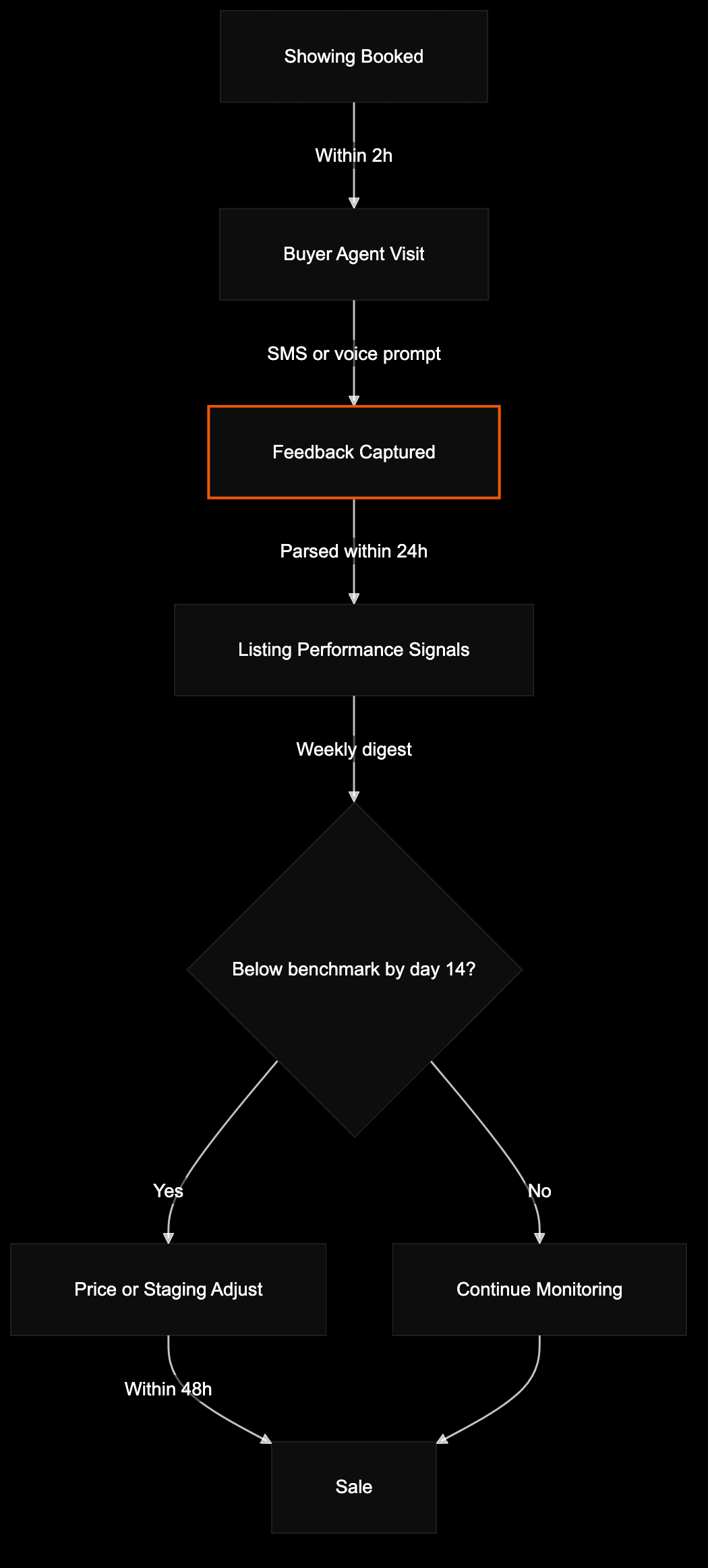
The feedback loop. Most listings bleed days at the capture step — buyer agent intel never reaches the seller.
The accent is on Feedback Captured. That's the bottleneck. Buyer agents don't fill out forms. The intel from showings — what the buyer said about the kitchen, why they passed, what comp they preferred — never reaches the seller. So the seller defends the list price for 45 days based on no information, and you're the agent explaining why.
A wired feedback loop fixes the capture step in three ways:
A 60-second voice or SMS prompt to the buyer agent within 2 hours of the showing, parsed by the system into structured fields.
A weekly performance digest to the seller that aggregates showing rate, feedback themes, and comparable activity — not raw data, interpreted data.
A pre-set adjustment trigger: if showing rate is below benchmark by day 14, the conversation about staging or price isn't a fight, it's a Tuesday review you both agreed to upfront.
With virtual staging tools (a $1.33B market in 2026, projected to $10.8B by 2033), the staging adjustment can happen in 48 hours instead of two weeks. The whole loop runs in under 18 days from list to first calibrated adjustment.
Stage 4 KPI: median days-on-market against the agent's own prior 12-month baseline. Operator benchmark: 20–35% compression in the first two quarters of running the loop.
The Numbers That Make or Break the Pitch
When you sit down with a seller, these are the numbers that close the room:
87% of brokerages use AI tools daily as of 2026, per HousingWire's industry benchmark. The seller's already heard the noise. You're differentiating on what you do with it.
5-minute response window translates to ~100x conversion lift on inbound seller leads. You can show the SLA.
72% predictive accuracy on seller intent at the 6–12 month horizon, per Smartzip's published methodology.
44% expired-relist rate within 30 days. If you're not the agent in their inbox by day 7, someone else is.
20–35% days-on-market compression when the feedback loop runs against the agent's own baseline. Show your last 10 listings, then show the projection.
This is the value story. Specific numbers, named mechanisms, defensible math. No hype words required.
What This Costs to Wire Up
Three brackets, based on what we've shipped at Entropy:
Solo top producer or 2–5 agent team. $4,000–8,000 to wire the four-stage system on top of existing tools (most teams already have the CRM, MLS access, and a comms stack). Ongoing $400–900/month in API and tooling costs. Time to first measurable lift: 60–75 days.
Mid-size brokerage, 20–80 agents. $18,000–35,000 for a shared system with per-agent personalization, including the buyer-agent feedback capture across the office. Ongoing $2,000–4,500/month. Time to lift: 75–90 days, with the bigger gain on Stage 2 because the data compounds across the brokerage's combined sphere.
Enterprise brokerage, 200+ agents. Custom builds in the $75,000–180,000 range, typically with multi-agent orchestration across acquisition, nurture, and listing operations, and a human-in-the-loop approver above defined spend or content thresholds. Time to lift: 90–120 days.
The ROI math is straightforward: if you list 24 homes a year at an average $12,000 commission, a 15% lift in win rate plus a 25% compression in days-on-market funds the solo bracket within the first quarter.
FAQ
How can AI help listing agents get more listings?
AI helps by scoring your existing CRM for 6–12 month seller intent (72% accuracy on top vendors), running an automated pre-listing nurture so you're familiar before a competitor pitches, and prepping listing presentations with hyperlocal pricing data. The wedge is the nurture stage, where most agents do nothing for 6 months while a competitor builds the relationship.
What is the best AI tool for finding seller leads?
There isn't a single best tool — there's a best stack. Smartzip and Offrs lead on predictive scoring of public records. Lofty's Homeowner Agent (launched April 2026) scores your existing CRM. REDX still leads on expired and FSBO data. The operator question is which two or three you wire together, not which single one you buy.
How does AI reduce days on market for residential listings?
By fixing the showing-feedback loop. Buyer agents rarely complete feedback forms, so seller intel arrives 3–4 weeks late and price adjustments happen on day 45 instead of day 14. AI prompts buyer agents within 2 hours, parses voice or SMS responses into structured data, and triggers staging or pricing reviews on pre-agreed thresholds. Compression of 20–35% is typical.
How accurate are AI predictive seller intent tools?
Leading vendors publish 70–75% accuracy at the 6–12 month horizon for likely-to-list prediction. That's high enough to prioritize outreach but not high enough to skip qualifying conversations. Treat the score as a ranking signal, not a verdict. The accuracy on your own CRM contacts is generally higher than on cold third-party data because you have engagement history.
Will AI replace listing agents?
No, and the question misses the actual shift. AI replaces the parts of the job that were already broken: cold prospecting, manual nurture, generic presentations, and lost showing feedback. The listing agent's role moves toward judgment calls — pricing strategy, negotiation, the kitchen-table conversation when an offer comes in soft. The agents being replaced are the ones who only did the broken parts.
The Operator Close
Wire prospect discovery this week. Run the pre-listing nurture in week two. Measure days-on-market against your last 10 listings by Friday of month two. If the numbers don't move, you've spent 60 days and learned exactly where your pipeline is leaking. If they do move, you have a system you can run for the next decade.
We build these for listing teams and brokerages at Entropy. Tuesday at 2pm or Thursday at 10am works on our end.